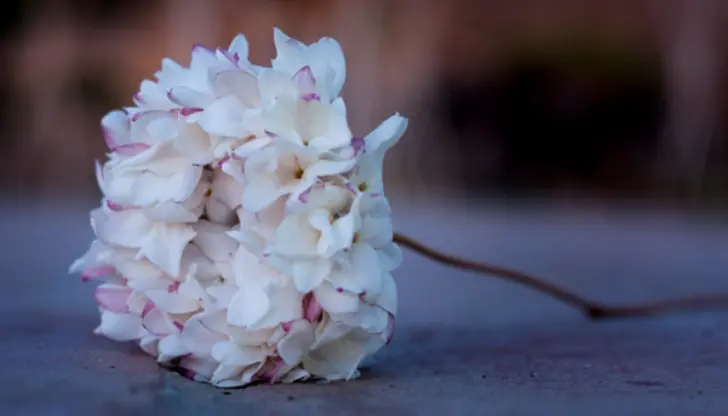
During your visit to Malaga city, you will probably be struck by some bouquets of white flowers that are sold on the street. These are the biznagas malagueñas, one of the great symbols of the city.
This creation, so characteristic of the Costa del Sol, has passed from the hands of artisans to be part of the institutional image of Malaga due to its fragrance, its shape and its production process.
What is biznaga and how is it made
Contrary to what many might think, biznaga is not a natural flower, but a handcrafted work made by hand from the nerdo plant - a variety of thistle - and jasmine flowers. Its manufacture combines patience, precision and technique.
To make the biznaga malagueña, the dried stem of the wild nerdo plant is first used, which serves as a support. Then, the closed buds of fresh jasmine are skewered one by one . As the hours go by, the jasmine opens and shapes a white, compact and perfumed sphere that gives off an unmistakable aroma.
Malaga biznaga: origin and relationship with the city
The origin of the word biznaga comes from the Hispanic Arabic basánqa, derived in turn from the Greek "bisnākon", the name of an aromatic plant. In Malaga, the tradition of making biznagas, as we know it today, was born during the nineteenth century.
But what is biznaga for? Beyond its beauty, biznaga has a practical function. Traditionally, it was used to perfume the environment during summer nights and, thanks to the scent of jasmine, also to ward off insects and mosquitoes naturally.
In those years, the biznagueros walked the streets of the center offering these aromatic flowers to neighbors and visitors. With the passage of time, biznaga became integrated into the daily life of the people of Malaga. It appeared at festivals, fairs and religious celebrations. Its image began to appear on tourist posters and, later, in artistic and literary representations, consolidating itself as a symbol of local identity.

The figure of the biznaguero:
guardian of a tradition
The biznaguero is the person in charge of selling the biznaga in the streets of the capital. With his characteristic attire: white shirt, red sash and black pants, he walks the streets with a tray of esparto grass or a stalk where the freshly made biznagas rest.
Beyond the trade, the biznaguero represents very Malaga values: hospitality, dedication and respect for local customs. In the Pedro Luis Alonso Gardens, next to the City Hall and at the foot of Puerta Oscura, you can see a sculpture that pays tribute to these anonymous artisans who are part of the soul of the city.
From the street to the cinema: the Golden Biznaga
As you may have seen, the biznaga is much more than a flower; a symbol that is part of the identity and history of Malaga. Its importance is such that, since 1998, it has given its name to the highest award of the Malaga Film Festival, the Golden Biznaga: an award for the best film of the festival.
The award, inspired by the city's most representative flower, unites the world of art and culture with local pride. Thus, the Malaga biznaga has gone from the streets to the international stages, consolidating itself as a cultural emblem that identifies Malaga inside and outside the province.
The biznaga, the spirit of Malaga
In short, the Malaga biznaga is an artisanal creation that encloses centuries of history, popular knowledge and Malaga pride. It represents the delicacy of the handmade, the value of customs and the warmth of a city that knows how to preserve its roots.
Anyone who visits Malaga cannot leave without seeing a biznaga or without perceiving its aroma. It is the most authentic memory of the province: a flower that, although it does not grow from the earth, blooms every day in the memory of its people.
01 December 2025