
The Costa del Sol hides under its land a millenary legacy that surprises those who venture to discover it. Beyond its beaches and white villages, this corner of southern Spain bears the imprint of Rome in the form of theatres, villas, baths, garum factories or mausoleums.
Exploring the monuments of the Roman period in the province of Malaga is a perfect plan for families: the little ones become little archaeologists, while the older ones enjoy a journey back in time among unique landscapes.
Do you want to discover the 10 essentials? Read!
Route through 10 Roman monuments in the province of Malaga
Roman Malaga was a strategic enclave in Hispania, with prosperous ports, fishing factories and villas facing the sea.
Today, many of these vestiges can be visited with the family, combining knowledge, culture and history with outdoor walks.
1. Roman Factory-Necropolis of Torrox
In the vicinity of the Torrox Lighthouse there is an archaeological site that includes a salting factory from the first century AD., with waterproofed pools where the famous garum was made and ceramic ovens to manufacture the transport containers.
With the passage of time, this space changed its function and in the fourth century it was reused as a necropolis.
2. Villa Antiopa in Rincon de la Victoria
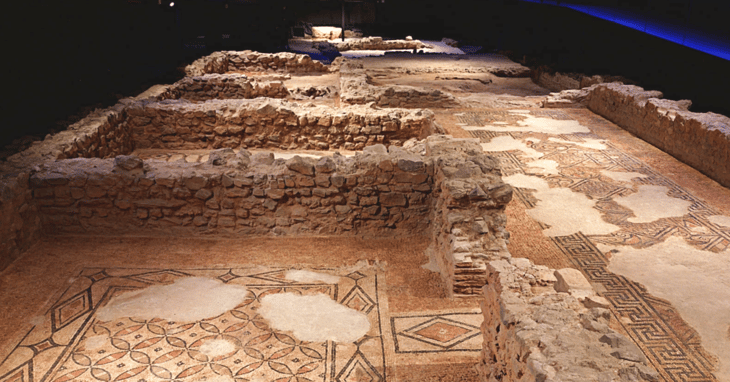
In Rincón de la Victoria is the Villa Antiopa, a Roman site from the third century AD declared an Asset of Cultural Interest.
This villa preserves residential rooms, bathrooms and warehouses, as well as mosaics of great value, among which the mythological scene in which Zeus, transformed into a satyr, seduces Antiopa stands out. Its economy was linked to the production of garum and salted fish, and after its restoration the enclave opened its doors to the public in 2022.
3. Roman Theatre of Malaga city
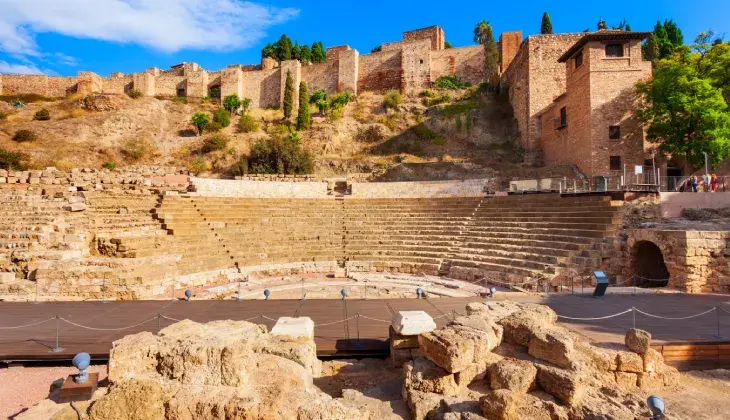
At the foot of the Alcazaba stands the Roman Theatre of Malaga, one of the emblems of the city. Its stands and orchestra continue to show the greatness of Roman shows.
The most curious thing is that under Alcazabilla Street the remains of garum factories were found, which shows that urban and industrial life were closely linked. A visit to the annexed Interpretation Centre is essential to understand Roman Malaga as a whole and its importance as a Mediterranean port.
4. Roman heritage in the Museum of Malaga
The Museum of Malaga, in the capital's Palacio de la Aduana, preserves a large number of vestiges from the time of Roman domination on its floor dedicated to Archaeology.
A portrait of Emperor Antoninus Pius (ca. 155-165 AD) found in the Huelin district; an impressive mosaic with the Birth of Venus found in Cartama, from the second century AD or the beginning of the third century AD; or some sculptures of matrons dated to the second century AD, and also excavated in the same town in Cartam, are some of the works of interest that you can find in these facilities, which will not leave you indifferent and will help you to know the Roman footprint on the Costa del Sol.
5. Roman Baths of Santa María de Antequera
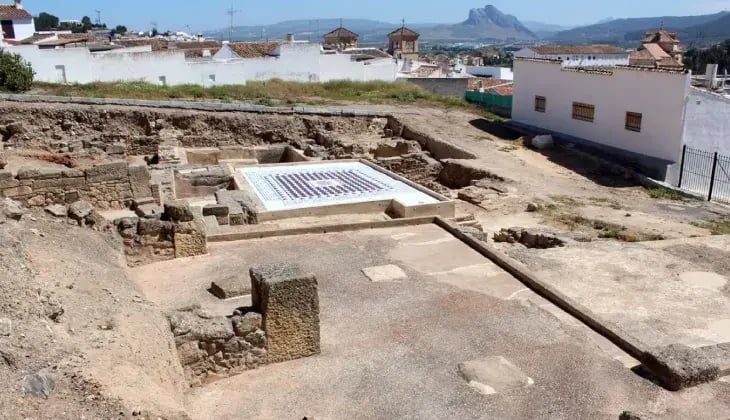
In the heart of the historic centre of Antequera are the Roman Baths of Santa María, discovered in 1988 and excavated until 1991. They were in use from the middle of the first century A.D. until the fifth century A.D. and they preserve the typical spaces of Roman baths: the frigidarium (cold room), the tepidarium (temperate) and the caldarium (hot).
Their discovery was the first clear evidence that the ancient Roman city of Antikaria was located under the current urban area.
6. Roman Columbarium of the Cortijo del Moro in Benalauría
In the municipality of Benalauría, near Cañada Real del Tesoro, which already belongs to the municipality of Cortes de la Frontera, in the heart of the Serranía de Ronda, the Roman Columbarium of Cortijo del Moro, a Roman mausoleum from the first century AD, is preserved.built in stone. Its interior, rectangular in plan and covered with a half-barrel vault, houses several niches for cinerary urns.
This unique funerary monument, protected as an Asset of Archaeological Interest, is one of the most valuable testimonies of the Roman past in the province of Malaga.
7. Acinipo Ruins – Ronda
Known as "Ronda la Vieja", Acinipo, northwest of Ronda, was a city that came to mint its own currency. The highlight is its Roman theater, with a part carved into the rock, which still conveys the emotion of the shows of 2,000 years ago.
In addition, the natural environment of the Serranía makes this visit a perfect combination of landscape and history.
8. Roman Baths of the Vaults of San Pedro de Alcántara
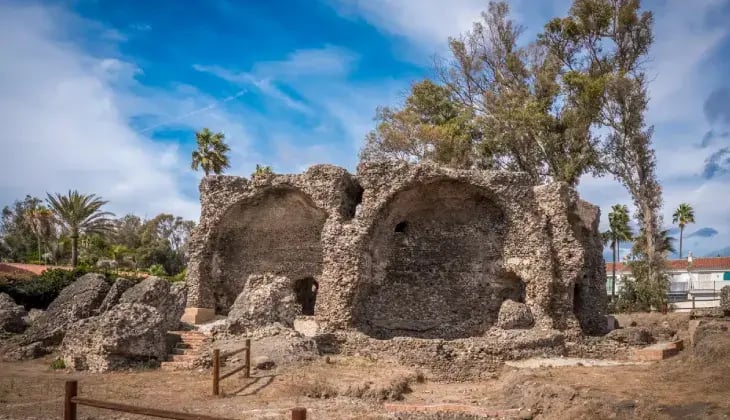
In San Pedro Alcántara, the Roman Baths of Las Bóvedas, a thermal building from the second century A.D., are preserved. which stands out for its unique central floor plan and the vaulted rooms that surround it.
Despite the passage of time, its structure allows us to appreciate the architectural complexity of the Roman baths and is one of the most valuable examples of Rome's footprint on the Costa del Sol.
9. Roman Villa of Río Verde – Marbella
In the Roman Villa of Río Verde, in Marbella, built between the first and second centuries AD, part of the pars urbana, the residential area of this old coastal town, is preserved.
The complex is organized around a porticoed courtyard with columns, whose corridors gave access to the different rooms. Its uniqueness lies in the fact that it is one of the few examples of Roman domestic architecture on the Andalusian coast. Its floors include black and white mosaics decorated with culi-nary utensils and food, unique in their kind, as well as the fa-mous Medusa, a polychrome mosaic with a central image of Gorgoneion surrounded by geometric motifs.
10. Baños de la Hedionda de Casares
Finally, in Casares there are the famous Baños de la Hedionda, a thermal complex of Roman origin linked to the healing properties of its sulphurous waters. The building retains an almost square floor plan covered by barrel vaults, which even today allow you to relive the experience of a historic bath.
Tradition has it that Julius Caesar himself ordered these baths to be conditioned after healing them of a skin condition, which made the place a famous space already in Antiquity.
Its mixture of history, legend and natural environment make it one of the most unique enclaves.
Experience the Costa del Sol with a Roman gaze
Exploring the monuments of the Roman denomination period of the province of Malaga is much more than a walk through history: it is an invitation to enjoy the destination from another perspective.
Between beaches, mountains and charming villages, these vestiges of Rome add a unique cultural value to the trip. Each visit becomes an experience that combines leisure, nature and heritage, perfect for sharing with the family.
Come, walk through these millenary footprints and discover how the Costa del Sol continues to surprise with treasures that connect past and present.
23 September 2025